WeedHack Malware Spreads Through Fake Minecraft Websites and SEO Poisoning
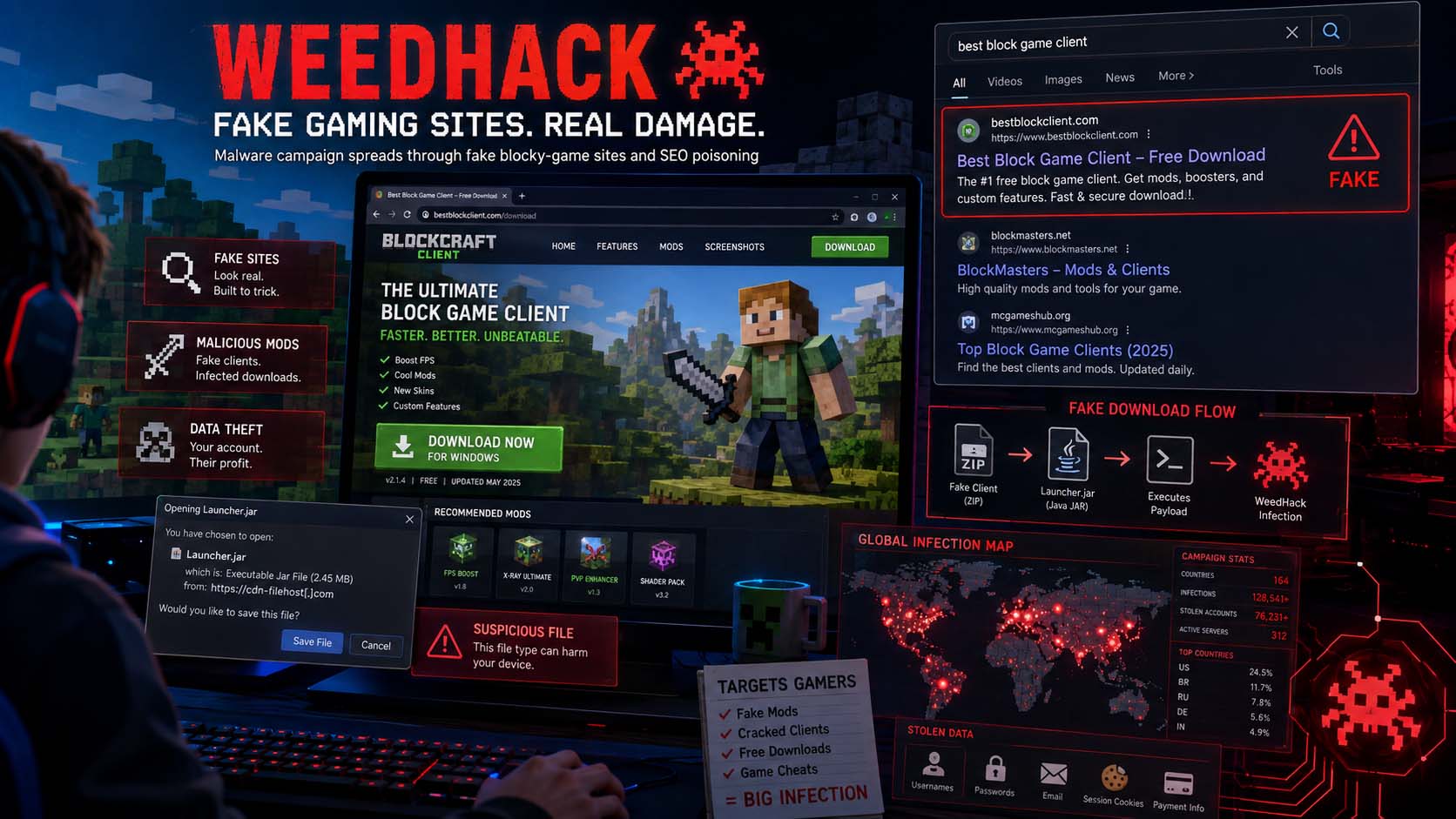
The WeedHack malware campaign continues to target Minecraft players through fake client websites, SEO poisoning, and trusted file-hosting services. Although the operation’s original command-and-control infrastructure was disrupted, researchers have discovered active websites still distributing malicious downloads designed to steal credentials, gaming sessions, files, and other sensitive data.
Cybersecurity researchers have uncovered a renewed wave of the WeedHack malware campaign, with attackers continuing to distribute malicious Minecraft clients and mods through convincing fake websites and search-engine manipulation.
According to McAfee Labs, WeedHack has evolved even after its original command-and-control infrastructure and dashboard were disrupted.
Attackers are now relying heavily on brand impersonation, SEO poisoning, and trusted file-hosting platforms to make malicious downloads appear legitimate.
Fake Minecraft Websites Mimic Legitimate Projects
One of the most effective techniques used in the campaign is the creation of websites that closely copy legitimate Minecraft projects.
Researchers found fake sites reproducing:
- Branding
- Feature lists
- FAQ sections
- Installation guides
- Developer credits
- Download pages
- Links to legitimate GitHub repositories
This level of detail makes it difficult for ordinary users to distinguish a malicious website from the real one.
In one case documented by McAfee, a fake site impersonating the legitimate Glazed Client project reproduced much of the original site's appearance and content.
All download options offered by the fake site delivered WeedHack malware.
SEO Poisoning Pushes Malware Into Google Results
The campaign also uses SEO poisoning to manipulate search-engine rankings.
Attackers optimize malicious websites for popular Minecraft-related searches such as:
- Minecraft clients
- Free premium clients
- Mods
- Cheats
- PvP tools
- Performance utilities
McAfee researchers observed a case in which the top two Google results for a popular Minecraft client led users to websites distributing WeedHack.
This attack technique is particularly effective because users often assume that highly ranked search results are trustworthy.
However, search ranking is not a security guarantee.
Cybercriminals can use aggressive SEO techniques, advertising, compromised domains, or AI-generated content to push malicious pages higher in search results.
More Than 6,300 Malicious Site Visits Blocked
McAfee WebAdvisor reportedly blocked more than 6,300 attempts to access malicious WeedHack-related websites during a single month.
Researchers emphasized that this figure represents blocked website visits rather than confirmed unique infections.
The continued traffic demonstrates that the campaign remains active and that Minecraft users are still encountering malicious download pages through search engines and other sources.
Trusted File-Hosting Platforms Are Being Abused
Attackers are not hosting all malicious payloads directly on suspicious infrastructure.
A significant portion of WeedHack download links were hosted on well-known services.
McAfee found that distribution URLs were approximately:
- 49.6% Discord
- 23.4% MediaFire
- 8.2% GitHub
- 4.6% Dropbox
The remaining links were primarily associated with websites created specifically to deceive victims.
Using recognizable services gives the attacker an additional layer of credibility.
A user may be less suspicious of a file hosted on Discord, GitHub, Dropbox, or MediaFire than a download served directly from an unknown domain.
WeedHack Previously Compromised More Than 116,000 Endpoints
WeedHack was first documented earlier in 2026 as a Malware-as-a-Service campaign targeting Minecraft players.
McAfee initially identified more than:
- 3,820 malicious JAR files
- 240 distribution URLs
The operation had reportedly recorded more than 116,000 campaign hits between January and June 2026.
This figure should not necessarily be interpreted as 116,000 independently verified infected users.
However, it demonstrates the scale at which the malware infrastructure was operating.
What Does WeedHack Steal?
WeedHack primarily targets Windows users downloading Minecraft Java Edition modifications.
Once executed, the first-stage malware can collect information associated with a victim's Minecraft account.
Earlier analysis found that the malware can steal:
- Minecraft display name
- Account UUID
- Microsoft OAuth access tokens
- Browser credentials
- Stored passwords
- Cryptocurrency wallet information
- Files and system information
Premium versions of the malware service have also reportedly included capabilities such as:
- Keylogging
- Webcam access
- Remote screen viewing
- Remote command execution
- File management
This turns what appears to be a simple fake Minecraft mod into a potentially full remote-access compromise.
Blockchain Infrastructure Used for C2 Discovery
One of WeedHack's more unusual technical characteristics is its use of blockchain infrastructure.
Earlier research found that the malware could query an Ethereum smart contract to obtain the address of its current command-and-control server.
This technique makes infrastructure more resilient.
Instead of hardcoding a single C2 domain inside every malware sample, attackers can update the address through the blockchain-based mechanism.
The malware can then retrieve the new destination dynamically.
This approach complicates traditional domain-based blocking because attackers can change backend infrastructure without rebuilding every malicious payload.
Attackers Changed Tactics After Infrastructure Disruption
McAfee reported that WeedHack's original C2 server and dashboard were no longer active following earlier investigation and disruption activity.
However, the shutdown did not eliminate the broader campaign.
Instead, attackers adapted their distribution methods.
Fake sites, malicious archives, and file-hosting links continue to circulate.
This is an important reminder that disrupting a malware command server does not necessarily remove:
- Existing malicious websites
- Search-engine results
- Cached download links
- File-hosting payloads
- Affiliate infrastructure
- Previously generated malware samples
Threat actors can also rebuild infrastructure under new domains.
How Gamers Can Protect Themselves
Users should be particularly cautious when downloading Minecraft modifications, clients, or cheats from unofficial sources.
Recommended precautions include:
- Download mods only from official developer pages or reputable mod platforms.
- Verify the exact domain before downloading software.
- Do not trust a website simply because it appears near the top of Google.
- Avoid pirated or “premium for free” game clients.
- Do not disable antivirus protection because a download page asks you to.
- Scan JAR and ZIP files before execution.
- Be cautious with links shared through Discord or YouTube.
- Use unique passwords and enable multi-factor authentication on Microsoft accounts.
- Revoke active sessions if a suspicious mod has already been executed.
- Change credentials from a clean device after suspected infection.
If a malicious JAR has already been executed, the affected system should be treated as potentially compromised.
Simply deleting the original file may not be enough if additional payloads or persistence mechanisms were installed.
Analysis and context
The renewed WeedHack campaign demonstrates how cybercriminals increasingly combine malware, social engineering, search manipulation, and trusted cloud services into a single distribution ecosystem.
The malware itself is only one part of the attack.
The more important problem is how users are convinced to execute it.
Search Engines Have Become Part of the Attack Surface
Traditional phishing education often tells users not to click suspicious links from unsolicited emails.
But WeedHack demonstrates a different model.
The victim may actively search Google for a Minecraft client and independently click one of the highest-ranking results.
There is no phishing email.
There may be no suspicious message at all.
From the victim's perspective, they are simply using a search engine normally.
This makes SEO poisoning especially dangerous.
Security awareness therefore needs to evolve beyond:
“Do not click suspicious links.”
Users also need to understand:
“A search result can be malicious even when you found it yourself.”
Brand Impersonation Is Becoming Harder to Detect
The fake WeedHack distribution sites are not necessarily low-quality phishing pages.
Attackers can copy nearly an entire legitimate project website.
They may reuse:
- Logos
- Screenshots
- Documentation
- Product descriptions
- FAQs
- Developer names
- Legitimate GitHub links
A user may inspect several parts of the website and still believe it is genuine.
The attacker only needs to replace one element:
the download button.
This demonstrates why domain verification is increasingly important.
Visual similarity is no longer enough to establish trust.
Trusted Platforms Can Host Malicious Content
Another important security lesson comes from the campaign's use of Discord, GitHub, MediaFire, and Dropbox.
Users often implicitly trust these domains.
But a legitimate hosting provider does not automatically make the hosted file safe.
This creates a difficult problem for both users and security teams.
Blocking an entire service such as GitHub or Discord may be impractical.
Organizations therefore need more granular controls such as:
- URL reputation
- File reputation
- Sandboxing
- Endpoint detection
- Download inspection
- DNS filtering
Trust must be applied to the actual content, not simply to the hosting domain.
Gaming Communities Are Attractive Cybercrime Targets
Minecraft is particularly attractive to cybercriminals because its ecosystem encourages users to install third-party content.
Players regularly download:
- Mods
- Resource packs
- Clients
- Shaders
- Plugins
-
- Launchers
Installing third-party code is therefore normal behavior in the community.
Attackers exploit that expectation.
The promise of a free premium client or popular mod requires much less social engineering than convincing an ordinary user to execute an unknown JAR file.
Malware-as-a-Service Lowers the Barrier to Cybercrime
WeedHack is also notable because it has operated as Malware-as-a-Service.
Attackers do not necessarily need to develop the malware themselves.
They can obtain a ready-made malicious platform and focus primarily on distribution.
Earlier McAfee research suggested that access to WeedHack could be extremely inexpensive, lowering the technical and financial barrier for would-be attackers.
This creates a broader cybersecurity problem.
Malware development, infrastructure, victim management, and credential theft can increasingly be offered as separate services.
A less-skilled attacker only needs to provide the victims.
Infrastructure Disruption Is Not the End of a Campaign
The continued WeedHack activity also shows why taking down a C2 server does not always end a malware operation.
Modern campaigns are distributed ecosystems.
They may include:
- Search-engine content
- Social-media accounts
- Fake websites
- File-hosting services
- Telegram or Discord communities
- Malware builders
- Blockchain-based configuration
- Multiple C2 servers
Removing one component can reduce attacker capability without eliminating the entire ecosystem.
Cyber defenders therefore need to disrupt campaigns at multiple layers simultaneously.
The larger lesson from WeedHack is clear:
Malware distribution is becoming
less about sending obvious malicious files and more about creating an entire online environment that convinces users the malware is legitimate.
For users, developers, search engines, hosting platforms, and cybersecurity teams, verifying the authenticity of software distribution channels is becoming just as important as detecting the malware itself.