Do Chinese Prompts Work Better in Seedance 2.5? Creator Tests Popular AI Video Prompting Myths
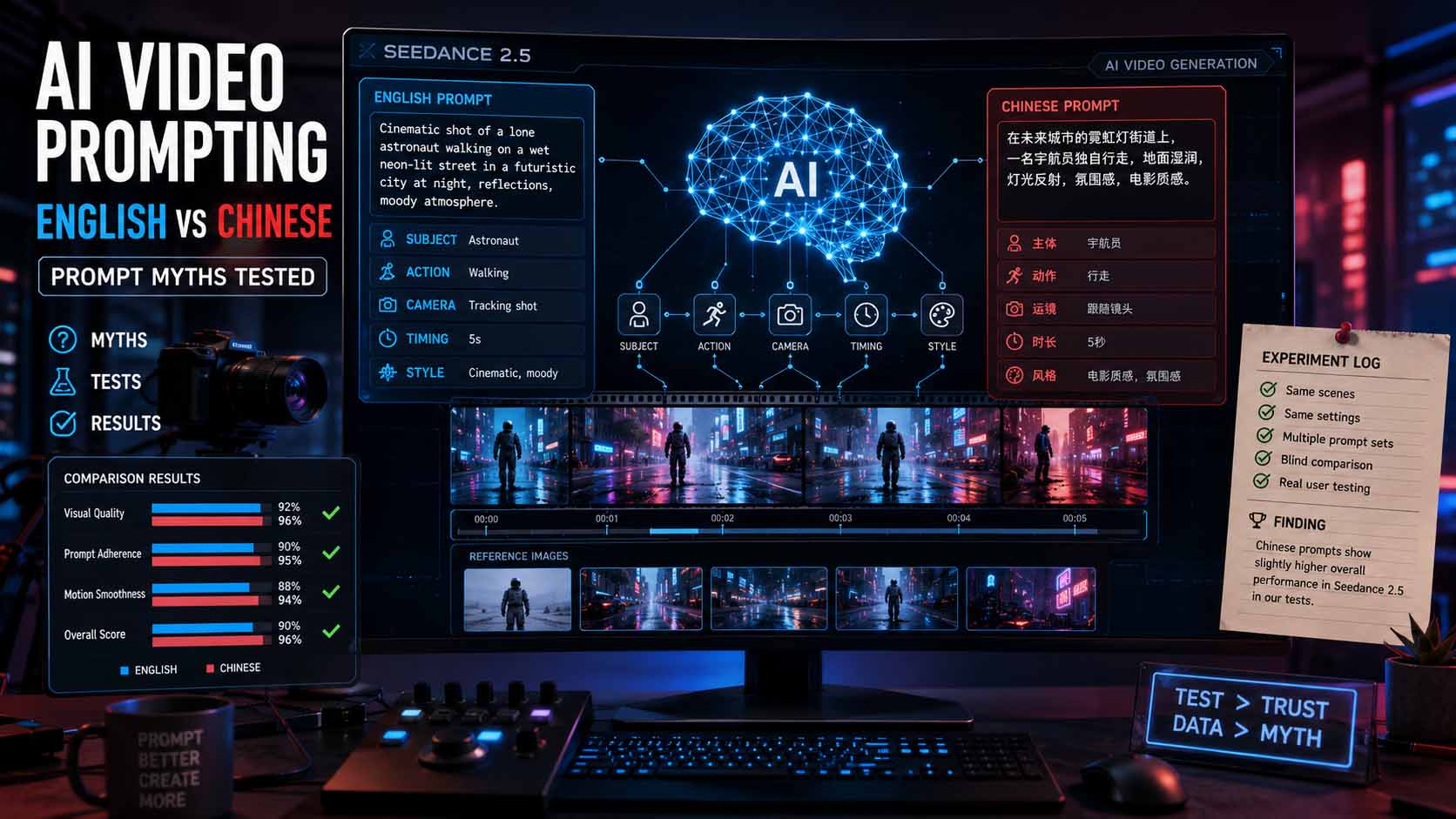
A new hands-on test explores whether writing prompts in Chinese improves results in ByteDance's Seedance 2.5 AI video model. The experiment challenges several popular prompting myths and suggests that prompt structure, timing, references, and clear production instructions may matter more than simply switching languages.
As AI video generators become increasingly capable, creators are developing their own theories about how to get better results from models such as ByteDance Seedance 2.5.
One of the most common claims is surprisingly simple:
Does Seedance perform better when prompts are written in Chinese?
A recent creator test explores this question while examining several other popular myths surrounding Seedance 2.5 prompting.
The video compares different prompting approaches and investigates whether language choice actually has a meaningful effect on generation quality.
Why Creators Think Chinese Prompts May Work Better
Seedance is developed by ByteDance, and a significant amount of early documentation, examples, and community experimentation around the model originated in Chinese.
This has led some users to believe that Chinese prompts may provide:
- Better instruction following
- More accurate camera movement
- Stronger character consistency
- Improved interpretation of complex actions
- Better cinematic composition
However, this assumption should not automatically be treated as a technical fact.
Modern multimodal models are trained on multilingual datasets, and Seedance 2.5 is designed to interpret prompts containing complex visual instructions across different languages.
The more important question may therefore be how the prompt is structured, rather than which language is used.
Seedance 2.5 Uses Structured Production Instructions
Prompting Seedance 2.5 increasingly resembles writing a small production brief.
Guides based on ByteDance's published prompting materials recommend describing elements such as:
- Subject
- Action
- Environment
- Camera movement
- Lighting
- Visual style
- Audio
Creators can also associate uploaded reference materials with specific elements inside a scene.
This makes prompts more deterministic than simply writing a long cinematic description.
Timing Can Be More Important Than Language
Seedance 2.5 can generate longer sequences than many earlier AI video models, making timing increasingly important.
For complex scenes, creators often define individual actions across specific time ranges.
For example:
0–5 seconds: Establishing shot and character introduction
5–12 seconds: Character moves through environment
12–20 seconds: Main action sequence
20–30 seconds: Final reveal or transition
Community testing suggests that assigning too many actions to a short time window can make scenes feel unnaturally accelerated.
Giving a simple action too much time can create the opposite effect, producing slow or awkward movement.
This suggests that temporal planning can have a greater influence on output quality than simply translating the same prompt into another language.
Longer Prompts Are Not Automatically Better
Another common misconception in AI video generation is that increasingly detailed prompts always produce better results.
That is not necessarily the case.
Seedance 2.5 appears to benefit from clear instructions with explicit relationships between subjects, actions, references, and camera behavior.
Adding unnecessary cinematic adjectives can make the instruction harder to interpret without providing additional useful information.
Practical Seedance guides therefore recommend production-oriented prompts rather than extremely long collections of descriptive keywords.
Reference Images Can Be More Valuable Than Extra Text
Seedance 2.5 places significant emphasis on multimodal reference material.
The model can work with combinations of:
- Images
- Video clips
- Audio
- Character references
- Environment references
- Product references
Instead of describing every visual characteristic in text, creators can directly associate references with specific elements of the requested video.
This may provide substantially stronger control over identity and visual consistency than repeatedly describing the same subject in natural language.
Chinese vs. English Prompts
The experiment raises an important distinction between language advantage and prompt advantage.
A carefully structured Chinese prompt may outperform a vague English prompt.
But that does not necessarily prove that Chinese itself is responsible for the improvement.
Variables such as:
- Prompt structure
- Shot planning
- Timing
- Reference usage
- Action clarity
- Camera instructions
can all change the result.
A fair comparison therefore requires testing semantically equivalent prompts while keeping the other generation parameters as consistent as possible.
Seedance 2.5 Pushes AI Video Toward Production Workflows
The broader trend is more significant than the language debate.
AI video prompting is gradually moving away from simple descriptions such as:
"Cinematic man walking through a futuristic city."
Newer workflows increasingly resemble:
Scene → Shot → Action → Camera → Timing → Reference → Audio
This gives creators more control but also requires more planning.
As AI video models improve, prompt engineering may increasingly resemble traditional directing and storyboarding rather than writing descriptive keywords.
Analysis and context
The debate around Chinese versus English prompts reflects a broader problem in generative AI communities:
successful experiments quickly become universal rules.
A creator may receive an excellent result after changing one variable and conclude that the variable caused the improvement.
But AI generation is probabilistic.
Different seeds, reference images, model versions, sampling settings, and internal processing can all affect results.
This makes controlled testing particularly important.
Prompt Myths Spread Quickly
AI communities frequently develop rules such as:
- “Always write prompts in Chinese.”
- “Long prompts are better.”
- “More cinematic keywords improve quality.”
- “Always specify every camera parameter.”
- “You need extremely detailed prompts.”
Some may work in specific scenarios, but they should not automatically be treated as universal requirements.
A better workflow is:
Test → compare → isolate variables → keep what consistently improves results.
Structure Is More Transferable Than Language
One of the most useful lessons from Seedance prompting is that structure tends to remain valuable regardless of language.
For example:
Subject → Action → Location → Camera → Lighting → Style → Sound
is a useful production framework whether the instructions are written in English or Chinese.
This is particularly relevant for professional creators because structured prompts can be reused across:
- Advertising
- Architectural visualization
- Short films
- Product videos
- Music videos
- Social media content
AI Prompting Is Becoming Directing
The evolution of models such as Seedance 2.5 suggests that the role of the prompt engineer is changing.
Instead of simply describing an image, the creator increasingly needs to think like a director:
- What happens first?
- Where is the camera?
- Which character performs which action?
- When does the camera move?
- Which reference controls the character?
- How long should each action last?
- What remains consistent between shots?
The quality of AI-generated video may therefore depend increasingly on visual storytelling knowledge rather than discovering secret prompt words.
The Chinese-versus-English experiment is useful precisely because it challenges the idea that there is a single shortcut to better AI video.
For professional workflows, the more reliable strategy is likely to be:
clear structure, controlled references, realistic timing, precise actions, and repeated testing.
Source: YouTube creator experiment — “What Happens If You Write Prompts in Chinese? Testing Seedance 2.5 Myths” — alongside publicly available Seedance 2.5 prompting documentation and community testing.