ChatGPT and Codex Recover After Major OpenAI Outage Ahead of Astra Launch
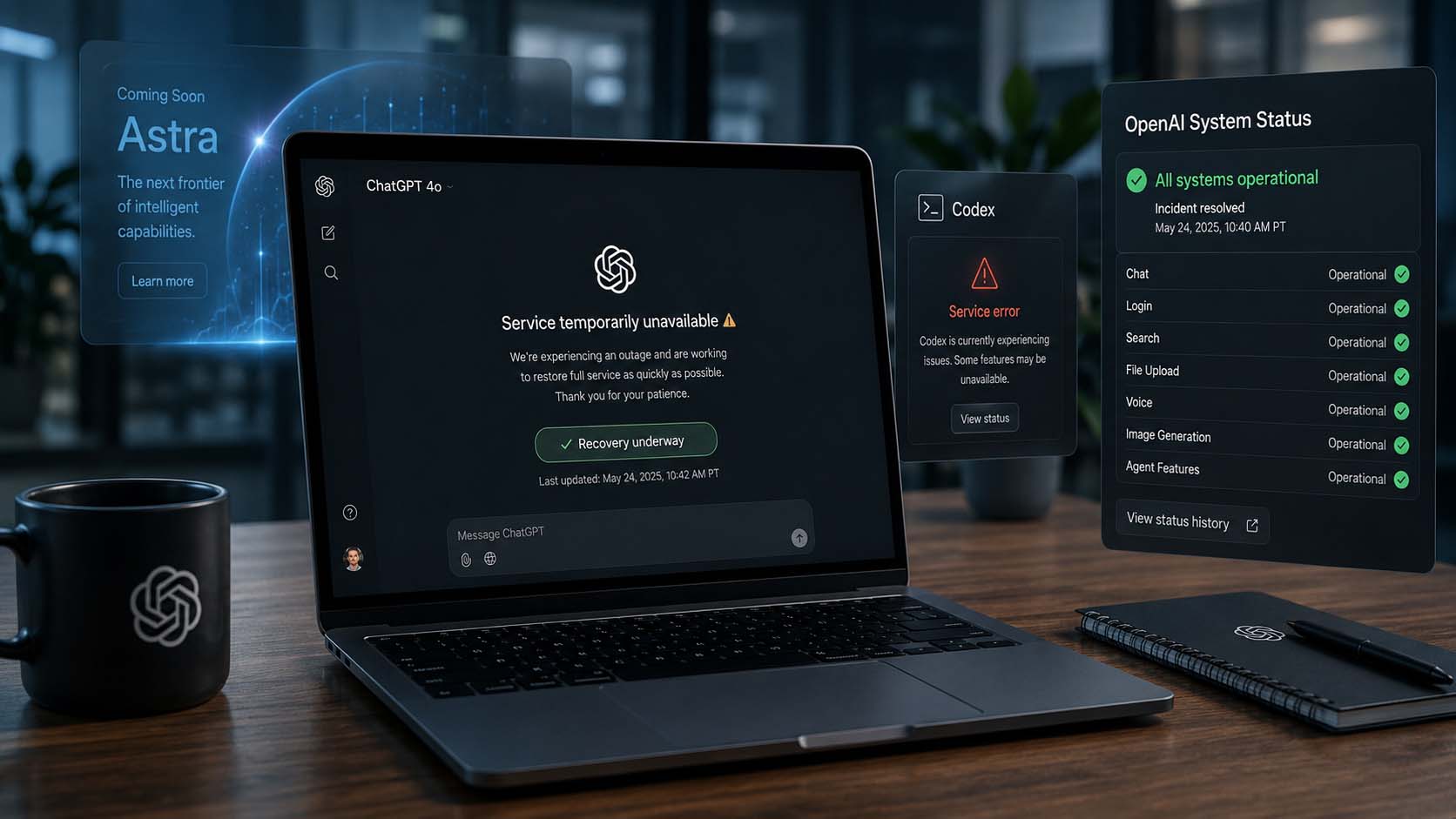
OpenAI has resolved a major outage that affected ChatGPT and Codex on September 3, 2026. The incident disrupted conversations, login, search, file uploads, Voice mode, GPTs, image generation, Deep Research, Agent features, ChatGPT Work, and other services. The disruption occurred shortly before the expected launch of OpenAI's upcoming Astra model, although there is no evidence linking the outage to the model rollout.
OpenAI experienced a significant service disruption on September 3, 2026, affecting ChatGPT and Codex and preventing users from accessing many of the company's core AI features.
The outage began at approximately 10:58 AM ET, according to BleepingComputer, with users reporting failures across a wide range of ChatGPT functions.
OpenAI later acknowledged the incident on its official status page and began investigating elevated error rates affecting both ChatGPT and Codex.
The company subsequently deployed a mitigation and confirmed that the incident had been fully resolved.
Multiple ChatGPT Features Were Affected
The outage was broader than a simple messaging failure.
OpenAI's status information indicated that 15 ChatGPT components and four Codex components were affected.
Users experienced problems with services including:
- ChatGPT conversations
- Login
- Search
- File uploads
- Voice mode
- GPTs
- Image generation
- Deep Research
- Agent
- ChatGPT Work
- Codex integration
- Connectors and apps
- ChatGPT Sites
Some users were unable to load existing conversations, while others encountered errors when attempting to send new messages or use advanced features.
OpenAI Investigated Elevated Errors
During the incident, OpenAI initially stated that it was investigating problems affecting the listed services.
The official incident timeline later showed that the company applied a mitigation and monitored recovery before declaring the issue resolved.
The final status update stated:
The issue causing elevated errors across ChatGPT and Codex has been resolved.
OpenAI also noted that some Codex remote-control users may need to pair their mobile devices again following the incident.
Outage Occurred Ahead of Expected Astra Launch
The timing of the outage attracted additional attention because it occurred shortly before OpenAI's anticipated launch of its next major AI model, Astra.
BleepingComputer reported that OpenAI had recently confirmed Astra would be released soon.
However, there is currently no evidence that the outage was connected to Astra preparations or deployment.
BleepingComputer itself noted that OpenAI had not linked the incident to the model launch and that service outages are not uncommon for large-scale AI platforms.
This distinction is important because temporal proximity does not establish causation.
ChatGPT Outages Affect an Increasing Number of Workflows
ChatGPT is no longer used only for ordinary text conversations.
OpenAI's platform now includes workflows involving:
- Coding
- Research
- File analysis
- Voice interaction
- Image generation
- Agentic workflows
- Workplace automation
- External connectors
- Software development through Codex
This means a broad outage can potentially interrupt many different business and individual workflows simultaneously.
The September 3 incident demonstrated this dependency clearly because failures were observed across nearly the entire ChatGPT feature set.
Codex Was Also Impacted
The incident was not limited to ChatGPT.
OpenAI's status page confirmed that four Codex-related components were also affected.
Codex has become increasingly important for software development workflows involving AI-assisted coding, repository interaction, and remote development tasks.
Failures affecting Codex may therefore impact developers differently from ordinary ChatGPT users.
The Incident Has Been Resolved
As of the latest OpenAI status update, the outage is no longer ongoing.
OpenAI marked the incident as Resolved at 4:55 PM on September 3, 2026 and confirmed that elevated errors across ChatGPT and Codex had been fixed.
This means the headline should ideally be written in the past tense if the article is being published now.
Rather than:
“ChatGPT Is Down”
a more accurate current headline would be:
“ChatGPT and Codex Recover After Major OpenAI Outage Ahead of Astra Launch.”
Analysis and context
The September 3 outage illustrates how important reliability has become as AI platforms evolve from standalone chatbots into critical productivity infrastructure.
A ChatGPT outage today affects significantly more workflows than it would have several years ago.
AI Platforms Are Becoming Infrastructure
Organizations increasingly use generative AI for:
- Development
- Data analysis
- Customer support
- Research
- Documentation
- Content creation
- Internal automation
When a major AI platform becomes unavailable, the impact begins to resemble an outage at other cloud or SaaS providers.
This changes how businesses should think about AI availability.
AI services should increasingly be included in:
- Business continuity planning
- Vendor risk management
- Incident response
- Dependency inventories
Feature Consolidation Increases Blast Radius
One important observation from this incident is the number of services affected simultaneously.
ChatGPT now provides many capabilities through one platform.
That improves usability, but it also creates a potentially larger blast radius when shared infrastructure experiences problems.
An incident may simultaneously affect:
**Chat
- Search
- Files
- Voice
- Images
- Agents
- Coding
- Connectors**
This type of dependency concentration creates operational risk for organizations that rely heavily on a single AI provider.
Businesses Should Avoid Single-Provider Dependency
Companies using AI for critical workflows should consider graceful fallback mechanisms.
Possible strategies include:
- Maintaining conventional non-AI workflows
- Supporting alternative AI providers for selected tasks
- Caching critical generated assets
- Avoiding hard dependencies on real-time model availability
- Monitoring provider status pages
- Implementing retry and queue systems for API workloads
The goal is not necessarily to replace one provider with another.
It is to ensure that a temporary AI outage does not completely stop a business process.
The Astra Timing Should Not Be Overinterpreted
The outage occurring before Astra's expected launch makes for an interesting headline, but it should not be interpreted as evidence of a connection.
No official information currently links the service interruption to the Astra rollout.
For cybersecurity and technology reporting, this distinction matters.
A responsible article should separate:
Confirmed:
ChatGPT and Codex experienced elevated errors.
Confirmed:
OpenAI investigated, mitigated, and resolved the incident.
Confirmed:
The incident happened shortly before Astra's expected release.
Not confirmed:
Astra caused the outage.
Monitoring Status Pages Matters
This story also demonstrates why outage reporting changes rapidly.
When BleepingComputer published the original article, OpenAI was still investigating the problem.
By the time of this updated article, OpenAI had already resolved the incident.
For technology news sites, status-page checks should therefore be part of the publishing workflow whenever reporting outages.
This prevents a headline such as “ChatGPT is down” from remaining online after the service has already recovered.