Actively Exploited Oracle WebLogic Flaw Allows Unauthenticated Access to Critical Data
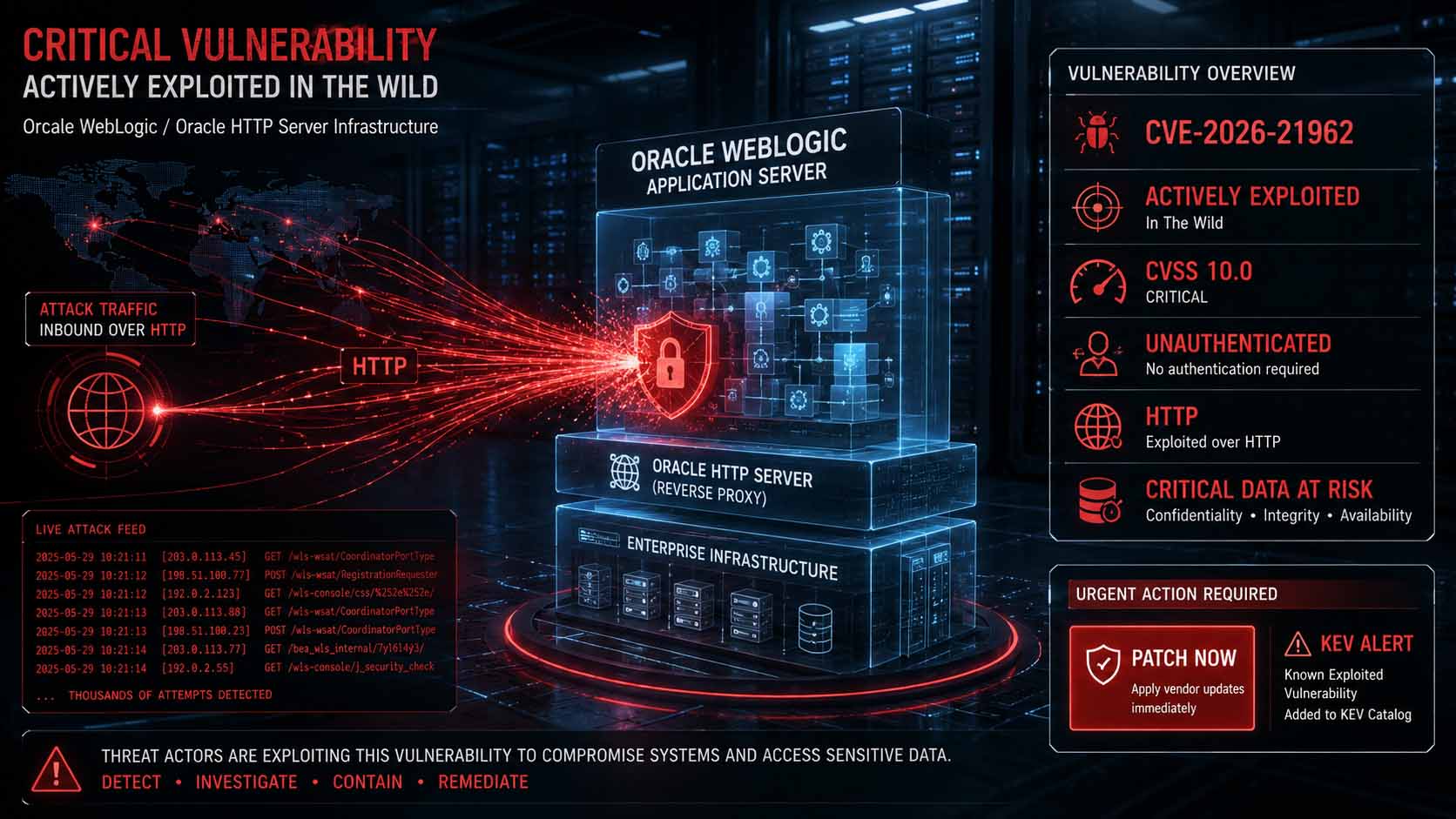
A critical Oracle Fusion Middleware vulnerability tracked as CVE-2026-21962 is being actively exploited in the wild. The flaw carries a maximum CVSS score of 10.0 and allows unauthenticated attackers with HTTP network access to compromise Oracle HTTP Server and Oracle WebLogic Server Proxy Plug-in deployments, potentially accessing or modifying critical data.
Cybersecurity authorities are warning organizations to urgently patch a critical Oracle vulnerability that is now being actively exploited in real-world attacks.
The vulnerability, tracked as CVE-2026-21962, affects components of Oracle Fusion Middleware, specifically:
- Oracle HTTP Server
- Oracle WebLogic Server Proxy Plug-in for Apache HTTP Server
- Oracle WebLogic Server Proxy Plug-in for Microsoft IIS
Oracle assigned the vulnerability a CVSS 3.1 score of 10.0, the maximum possible severity rating.
No Authentication Required
One of the most dangerous characteristics of CVE-2026-21962 is that attackers do not need valid credentials.
Oracle describes the vulnerability as easily exploitable by an unauthenticated attacker who has network access to the affected environment over HTTP.
The vulnerability requires:
- No authentication
- No user interaction
- Low attack complexity
- Remote network access over HTTP
A successful attack can provide unauthorized access to sensitive information and allow attackers to create, delete, or modify critical data accessible through the vulnerable Oracle components.
Affected Oracle Versions
Oracle lists the following versions as affected:
- 12.2.1.4.0
- 14.1.1.0.0
- 14.1.2.0.0
For the WebLogic Server Proxy Plug-in for Microsoft IIS, Oracle specifically notes that version 12.2.1.4.0 is affected.
Organizations running these versions should verify whether the relevant Oracle HTTP Server or WebLogic proxy components are installed and exposed to untrusted networks.
CISA Confirms Active Exploitation
On August 24, 2026, the U.S. Cybersecurity and Infrastructure Security Agency added CVE-2026-21962 to its Known Exploited Vulnerabilities (KEV) Catalog.
Inclusion in the KEV catalog means there is evidence that attackers are exploiting the vulnerability in real-world environments.
CISA lists the vulnerability as:
Oracle HTTP Server and Oracle WebLogic Server Proxy Plug-in Improper Access Control Vulnerability
The required remediation date for applicable U.S. federal environments is August 27, 2026.
CISA instructs organizations to apply vendor-provided mitigations or discontinue use of the affected product when appropriate mitigations are unavailable.
Patch Has Been Available Since January
The vulnerability itself is not new.
Oracle originally addressed CVE-2026-21962 in its January 2026 Critical Patch Update.
The issue was therefore publicly known and patched months before CISA confirmed active exploitation in August.
This is a common pattern in enterprise attacks.
Threat actors frequently focus on vulnerabilities for which patches already exist because many organizations delay updates due to:
- Compatibility concerns
- Legacy application dependencies
- Complex change-management procedures
- Limited maintenance windows
- Lack of accurate asset inventories
Once reliable exploit techniques become available, unpatched internet-facing servers can become attractive targets.
Public Proof-of-Concept Increased the Risk
Public information related to exploiting CVE-2026-21962 appeared shortly after Oracle released its January update.
The Canadian Centre for Cyber Security noted that a proof-of-concept became publicly available on January 21, 2026, one day after Oracle's advisory was released.
CISA's later addition of the flaw to KEV confirms that exploitation progressed beyond proof-of-concept research into real-world activity.
What Can an Attacker Do?
Oracle's vulnerability description emphasizes confidentiality and integrity impact.
Successful exploitation can potentially allow an attacker to:
- Access critical information
- Read data available through vulnerable components
- Create unauthorized data
- Delete existing information
- Modify critical information
- Affect connected products because the vulnerability involves a scope change
The CVSS vector is:
CVSS:3.1/AV:N/AC:L/PR:N/UI:N/S:C/C:H/I:H/A:N
This reflects remote exploitation, low complexity, no privileges required, and high confidentiality and integrity impact.
WebLogic Infrastructure Is a High-Value Target
Oracle WebLogic Server is widely used in enterprise environments for hosting Java-based applications and middleware services.
Deployments can support:
- Financial applications
- Enterprise portals
- Government systems
- Authentication services
- Internal APIs
- Large business applications
As a result, a vulnerable WebLogic-related component can provide attackers with access to systems containing highly valuable enterprise data.
Internet-facing middleware should therefore be treated as a high-priority security asset.
Recommended Security Actions
Organizations using Oracle WebLogic or Oracle HTTP Server should take immediate action.
Recommended measures include:
- Apply Oracle's security patches for CVE-2026-21962 immediately.
- Confirm the exact Oracle HTTP Server and WebLogic Proxy Plug-in versions deployed.
- Identify internet-facing Oracle middleware systems.
- Restrict HTTP and HTTPS access to trusted networks where possible.
- Review reverse proxies and WebLogic plug-in configurations.
- Search logs for unusual or unauthorized HTTP requests.
- Investigate unexpected file or configuration changes.
- Monitor authentication and application traffic for abnormal activity.
- Remove unsupported Oracle components.
- Segment middleware systems from critical internal infrastructure.
- Rotate sensitive credentials if compromise is suspected.
Oracle strongly recommends applying Critical Patch Update patches as soon as possible and notes that restricting network protocols required for exploitation may reduce risk until updates can be deployed.
Analysis and context
CVE-2026-21962 is a good example of why vulnerability severity cannot be evaluated using CVSS alone.
A CVSS score of 10.0 already makes this vulnerability critical.
However, three additional factors make the risk substantially higher:
1. No authentication is required
Attackers do not need an existing user account.
2. Exploitation occurs remotely
The attacker only needs network access to the vulnerable HTTP service.
3. Active exploitation is confirmed
CISA has added the vulnerability to the KEV catalog.
When all three factors exist simultaneously, patching should become an emergency priority.
Internet-Facing Middleware Is Particularly Dangerous
Organizations sometimes focus vulnerability management primarily on:
- End-user devices
- Windows endpoints
- VPN gateways
- Firewalls
But middleware platforms such as WebLogic can be equally critical.
They often sit between internet-facing applications and sensitive backend systems.
A compromise can therefore expose more than the middleware server itself.
Depending on architecture and permissions, attackers may gain opportunities to access:
- Databases
- Application credentials
- Internal APIs
- Authentication systems
- File stores
- Business data
This makes segmentation extremely important.
Patch Age Does Not Reduce Vulnerability Risk
CVE-2026-21962 was patched in January 2026.
Its active exploitation months later illustrates an important cybersecurity principle:
A vulnerability does not become less dangerous because a patch has existed for a long time.
In many cases, the opposite happens.
As time passes:
- Proof-of-concept code appears
- Researchers publish technical details
- Attackers automate exploitation
- Vulnerability scanners add detection
- Botnets scan the internet for exposed systems
Eventually, exploitation can become significantly easier.
CISA KEV Should Influence Patch Prioritization
Security teams managing thousands of vulnerabilities cannot always patch everything immediately.
This is why vulnerability prioritization should consider more than CVSS.
A useful priority model should include:
- Active exploitation
- Internet exposure
- Asset importance
- Authentication requirements
- Exploit availability
- Potential business impact
A vulnerability with CVSS 10.0 and confirmed exploitation should normally be prioritized above a similarly rated vulnerability with no known exploitation.
Network Segmentation Limits Damage
Even after patching, organizations should review how Oracle middleware communicates with other systems.
A compromised web-facing middleware server should not automatically have unrestricted access to:
- Database networks
- Domain controllers
- Administrative interfaces
- Backup infrastructure
- Management networks
Network segmentation and least-privilege access can significantly reduce the impact of an application-server compromise.
Vulnerability Management Is Ultimately an Exposure Problem
The most important lesson from CVE-2026-21962 is that vulnerability management is not simply a patch-counting exercise.
Security teams need to know:
- Which systems are vulnerable?
- Which systems are exposed to the internet?
- Which applications depend on them?
- What data can those systems access?
- Has exploitation already occurred?
Without an accurate asset inventory, even an available patch cannot protect a server that security teams do not know
exists.
The combination of a CVSS 10.0 rating, unauthenticated remote exploitation, public exploit information, and confirmed real-world attacks makes CVE-2026-21962 an urgent issue for organizations operating affected Oracle infrastructure.