24 npm Packages Abuse unpkg Mirrors to Host Fake Cloudflare CAPTCHA Pages
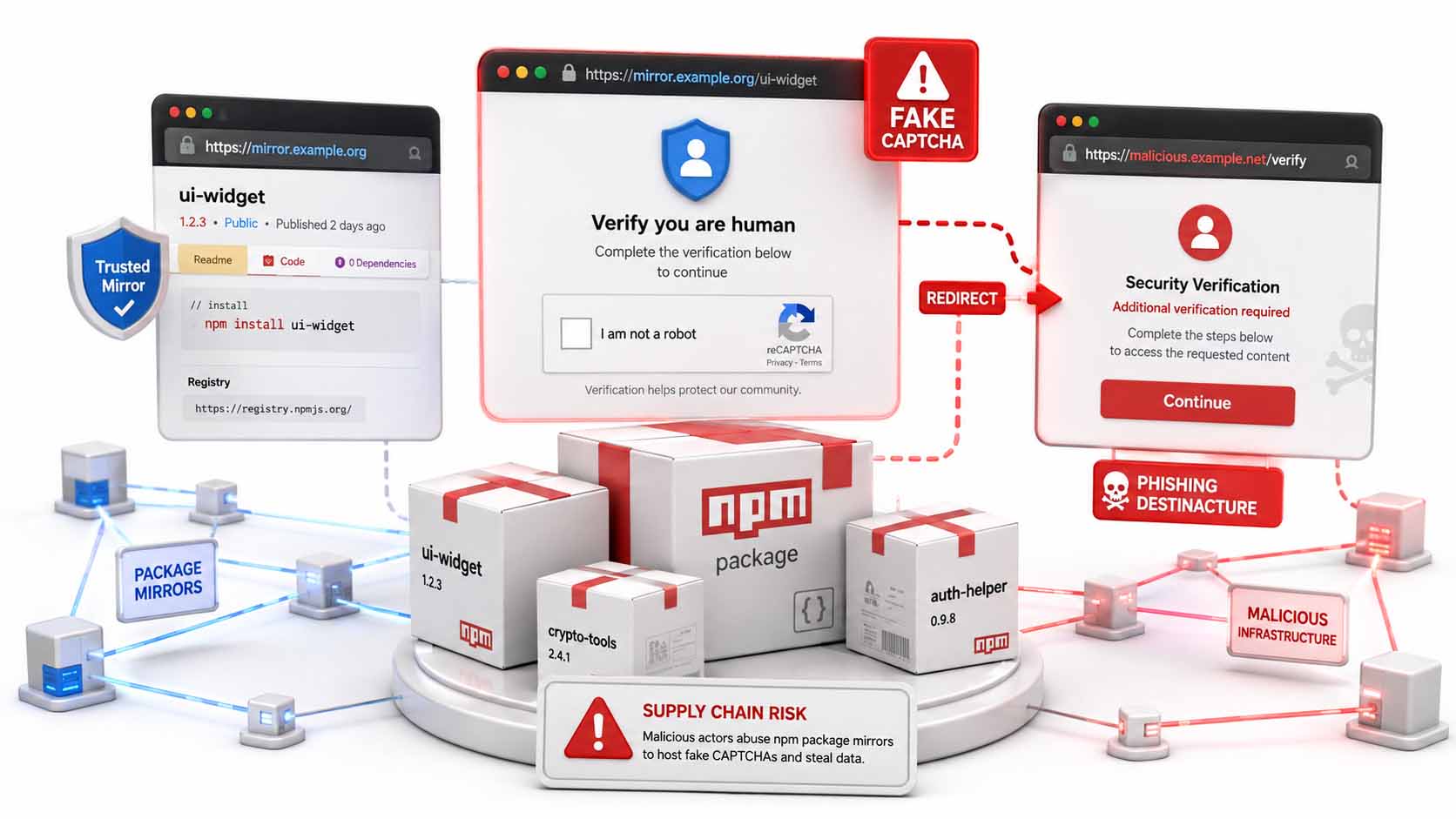
Security researchers have uncovered a campaign involving 24 malicious npm packages that abuse package mirrors such as unpkg to host fake Cloudflare CAPTCHA pages on trusted domains. The campaign does not primarily target developers who install the packages. Instead, attackers use npm mirrors as free and reputable frontend hosting for phishing pages that can redirect victims to ClickFix-style malware delivery or credential theft infrastructure.
Cybersecurity researchers have disclosed a phishing campaign that abuses the npm ecosystem in an unusual way.
Instead of focusing on malware execution directly through package installation, the attackers published 24 npm packages containing a single malicious HTML page. Once those packages were mirrored by services such as unpkg, yarn, npmmirror, and Tencent mirrors, the embedded HTML files became directly accessible through trusted mirror domains. This allowed the attackers to turn legitimate package delivery infrastructure into free phishing-page hosting. 【turn588055view0†L19-L21】
How the Attack Works
The campaign uses a simple but effective technique.
Each malicious npm package contains an HTML file. When that file is opened through a mirror URL, the user is shown a fake Cloudflare verification page. The page then runs JavaScript that contacts attacker-controlled infrastructure and redirects the victim to another destination. 【turn588055view0†L29-L33】
In other words, the real abuse is not the npm package installation itself. The threat actor is using the npm registry and its mirrors as a trusted content distribution layer for malicious web pages.
A mirror URL such as a direct index.html path on a trusted npm mirror can therefore act as a phishing entry point, even though the domain itself appears legitimate.
Installation Alone Is Not the Main Threat
An important clarification from the researchers is that installing the packages is not what directly compromises the victim.
The packages are not primarily designed to infect developers who run npm install. Instead, the packages act as containers for malicious HTML content that becomes reachable on package mirror sites. Victims are exposed when they open those hosted pages and follow the social-engineering flow. 【turn588055view0†L19-L21】【turn588055view0†L95-L97】
This distinction matters because the campaign is fundamentally an infrastructure abuse case rather than a traditional software-supply-chain compromise in which malicious code executes automatically during package installation.
Fake Cloudflare CAPTCHA and ClickFix Risk
The phishing pages impersonate Cloudflare verification prompts.
These fake CAPTCHA-style pages are designed to build trust and make the victim believe that a routine verification step is required before continuing. In similar ClickFix-style campaigns, the final objective is often to convince victims to perform actions that lead to:
- Malware execution
- Malicious script pasting
- Downloading a secondary payload
- Visiting credential-harvesting pages
Researchers said the current remote logic observed in the campaign was redirecting users to the legitimate ChatGPT website at the time of analysis, but the same mechanism could be reconfigured at any time to point to ClickFix malware delivery or phishing destinations instead. 【turn588055view0†L44-L47】
From Microsoft Typosquat to KeyVal
Researchers observed an evolution in the campaign.
Earlier variants sent requests to a typosquatted Microsoft-themed domain: login[.]microsofte[.]live. After that domain was blocked, the attackers shifted to using api.keyval.org, a legitimate public key-value service, as a dead drop resolver. 【turn588055view0†L37-L45】【turn588055view0†L82-L88】
This means the phishing page does not have to hardcode the final malicious destination. Instead, it can retrieve an encoded value from a legitimate service, decode it, and then redirect the victim.
That approach provides flexibility and makes the campaign more resilient because the attacker can change redirect targets without rebuilding the original HTML page.
Affected Packages
OX Security documented 24 malicious npm packages tied to this campaign.
The package list included names such as:
bgzxcuite2prezdentkxheiwndmxchdjxn2@worrisome/reutilmndsxcusiwlk1mobiwaefhxc3
Researchers categorized them into families associated with either the earlier Microsoft-typosquat logic or the newer KeyVal-based logic. Several packages had already been taken down, but many were still marked live at the time of publication. 【turn588055view0†L55-L81】
Why This Technique Is Dangerous
The campaign is dangerous because it abuses trusted infrastructure.
Users are generally trained to be suspicious of unknown domains. But in this case, the malicious HTML pages are reachable from domains associated with legitimate npm mirror services. That increases the chance that:
- Users trust the link
- Security tools assign lower risk
- Reputation-based filtering misses the threat
- Analysts underestimate the phishing potential of software delivery infrastructure
The phishing page itself is lightweight, and mirror services can continue serving content even after the original package is removed from the primary registry in some cases. This creates a persistence problem for defenders. 【turn588055view0†L91-L94】
Recommended Security Measures
Organizations should treat npm mirror infrastructure more carefully than before.
Recommended actions include:
- Treat mirror domains such as unpkg, npmmirror, yarn, and Tencent mirrors as potential phishing hosts when they are not being used for normal package retrieval.
- Add npm mirror URLs to phishing detection, web-filtering, and URL-reputation workflows.
- Monitor proxy, DNS, and web logs for direct requests to
.htmlfiles hosted inside mirrored packages. - Educate users that a trusted domain does not automatically mean that the hosted page is safe.
- Investigate suspicious “Cloudflare verification” prompts that appear from unexpected contexts.
- Block or review access to known IoCs such as
login[.]microsofte[.]liveand suspicious use ofapi.keyval.orgwhen applicable. 【turn588055view0†L22-L26】【turn588055view0†L82-L88】
Analysis and context
This campaign highlights an important evolution in threat actor behavior:
attackers increasingly abuse legitimate developer infrastructure not to compromise developers directly, but to host and deliver malicious web content.
That difference is strategically important.
When security teams hear “malicious npm package,” they often assume a classic package-level compromise involving post-install scripts, credential theft, or backdoored code inside a dependency tree. This case is different.
The npm packages serve primarily as storage containers for phishing HTML pages.
Trusted Infrastructure Is Becoming the Payload Host
The biggest lesson from this campaign is that trust in infrastructure can be weaponized.
If the phishing page were hosted on a random newly registered domain, defenders would have a better chance of blocking it through standard reputation systems.
But when the phishing content is accessible through a well-known mirror service, the attacker benefits from:
- Brand trust
- HTTPS on a reputable domain
- Easier delivery
- Reduced cost
- Lower friction for hosting updates
This makes the campaign less about malicious code execution inside the software supply chain and more about content hosting abuse inside the open-source ecosystem.
Domain Reputation Alone Is Not Enough
Traditional web filtering often relies heavily on domain-level trust.
This campaign shows why that model is incomplete.
A legitimate domain can still host:
- Phishing pages
- Redirectors
- Obfuscated scripts
- Malware staging content
- Social-engineering lures
Security controls increasingly need path-level and content-level inspection, not just domain-based allow/block decisions.
For example, a request to a mirror domain’s raw HTML path may deserve more scrutiny than a normal .tgz package fetch by a package manager.
ClickFix Continues to Spread as a Social-Engineering Model
Although the observed redirect logic was sending victims to ChatGPT at the time of analysis, the researchers correctly note that the same mechanism can be weaponized for ClickFix or phishing campaigns. 【turn588055view0†L44-L47】
That matters because ClickFix-style attacks are popular precisely because they shift the malicious action onto the user.
Instead of exploiting a browser vulnerability, the attacker convinces the victim to:
- Paste commands
- Execute scripts
- Approve prompts
- Download payloads
This keeps the infrastructure flexible and lowers the barrier to reuse across different campaigns.
Open-Source Abuse Does Not Always Mean a Developer-Focused Attack
Another useful lesson is that not every npm-related threat is fundamentally a developer threat.
This campaign can affect anyone who opens the mirror-hosted page, even if they are not using npm as a development tool.
That expands the threat model.
Security teams should consider that open-source registries and mirrors may be abused as part of broader phishing ecosystems targeting ordinary users, employees, or customers.
Long-Term Defensive Implication
The longer-term implication is clear:
software ecosystem infrastructure should be monitored not only for malicious packages, but also for malicious hosting behavior.
Registries, mirrors, and CDNs are increasingly valuable to attackers because they provide trusted delivery channels.
Future abuse may extend beyond HTML phishing pages into:
- Payload staging
- Redirector chains
- Obfuscated JavaScript loaders
- Fake login portals
- Social-engineering landing pages
Defenders will need better visibility into how trusted package infrastructure is being used outside its expected software-distribution purpose.
Source: OX Security research, August 25, 2026; additional reporting via The Hacker News.