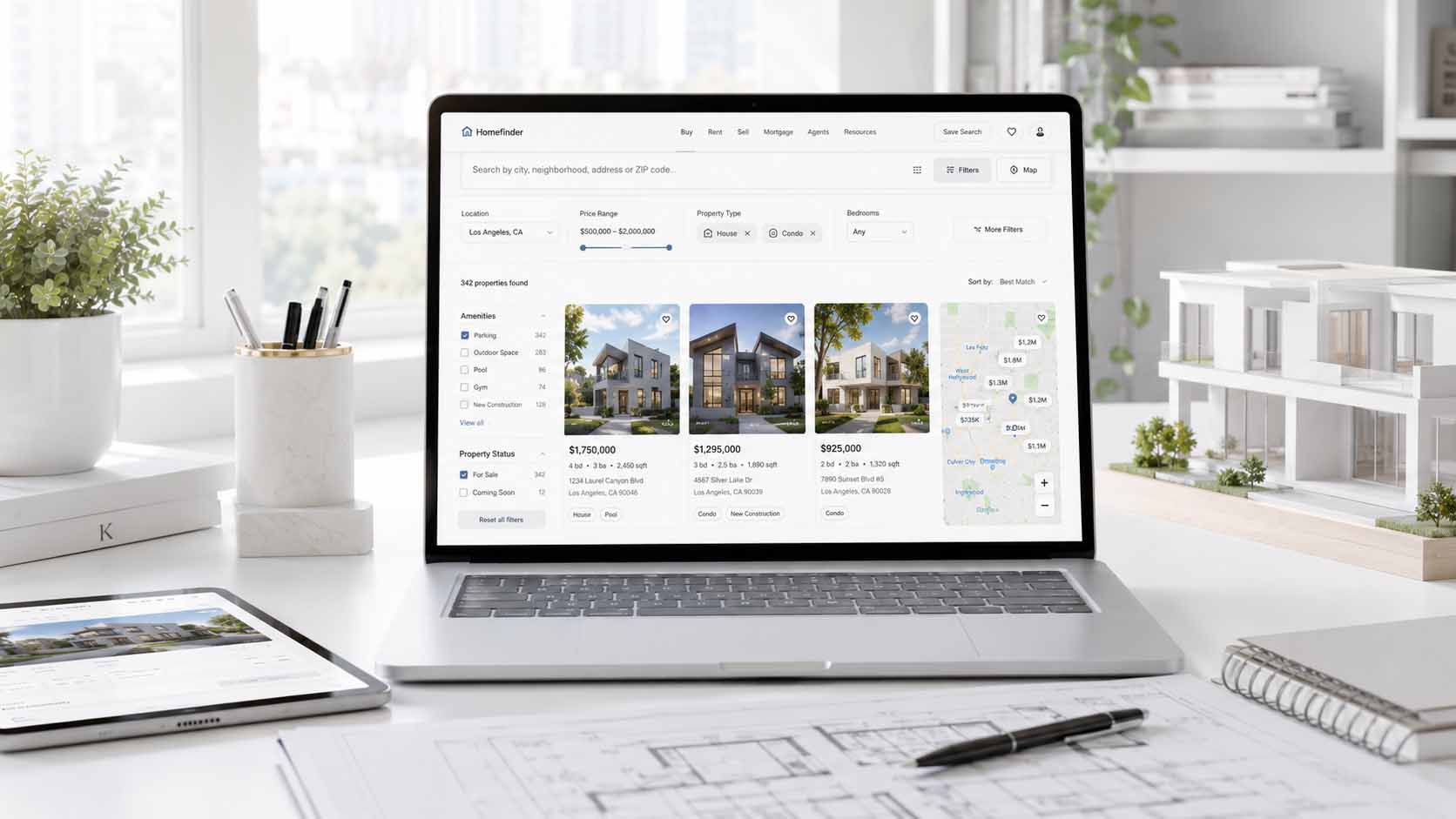
Why Search and Filtering Can Make or Break a Real Estate Platfo
When people think about real estate websites, they often focus first on the visual side: large property photos, clean layouts, beautiful cards, and polished detail pages.
When people think about real estate websites, they often focus first on the visual side: large property photos, clean layouts, beautiful cards, and polished detail pages.
Those things matter.
But in practice, one of the most important parts of a property platform is much less glamorous: search and filtering.
If users cannot quickly find relevant properties, the rest of the website becomes much less useful.
This is something that becomes very clear when working on a real estate platform like HomeNest. A property website can contain hundreds of high-quality listings, but without a good discovery experience, users may still struggle to find what they actually want.
Users Usually Arrive With an Intent
Most visitors do not open a real estate platform simply to browse randomly.
They often already have a rough idea of what they are looking for.
Maybe they want:
- an apartment in a specific area,
- a villa under a certain budget,
- a two-bedroom property,
- a rental rather than a purchase,
- or a property with particular amenities.
The job of the platform is to reduce hundreds of possibilities into a small number of relevant results.
That makes search much more than a technical feature.
It becomes one of the main parts of the user experience.
Too Few Filters Create Friction
A platform with only a basic location search may look simple, but it can quickly become frustrating.
If a user has to open ten property pages just to discover that none of them fit their budget, the experience has already failed.
At a minimum, most real estate platforms benefit from filters such as:
- Location
- Property type
- Price range
- Bedrooms
- Bathrooms
- Property size
- Sale or rent
- Amenities
The exact filters depend on the business model, but the principle is the same.
Users should be able to narrow results without unnecessary effort.
Too Many Filters Can Be Just as Bad
There is another side to this problem.
A platform can also become too complicated.
Imagine opening a search page and immediately seeing twenty-five dropdowns, sliders, checkboxes, and advanced options.
Technically, this may offer maximum control.
From a UX perspective, it can feel overwhelming.
A better approach is usually progressive complexity.
Show the most common filters first.
Then allow users to access more advanced options only when they need them.
For example, price, location, property type, and bedrooms can stay visible, while less common filters such as floor level, construction year, parking type, or specific amenities can remain inside an advanced section.
Good filtering is not about showing everything.
It is about helping users make decisions quickly.
Backend Design Matters More Than the UI Suggests
A filtering interface may look simple on the frontend, but the backend work behind it can become complex.
If every filter combination produces slow database queries, the website will feel sluggish.
As the number of listings grows, query design becomes increasingly important.
A scalable property platform may need:
- database indexes,
- optimized queries,
- pagination,
- caching,
- structured location data,
- and eventually dedicated search infrastructure.
For a small property database, a relational database may be more than enough.
For a much larger marketplace, search requirements can change significantly.
The important part is designing the data model in a way that does not make future growth unnecessarily difficult.
Location Should Be Treated as Structured Data
Location is one of the most important filters in real estate.
It is also one of the easiest areas to design poorly.
If every property stores location as a free-text field, users may end up with inconsistent values such as:
Baku
Bakı
Baku City
Central Baku
That creates problems for filtering, SEO, reporting, and administration.
A structured hierarchy works much better.
For example:
Country → City → District → Community
or
Country → City → Area
depending on the market.
This gives the platform a consistent structure that can later support filters, URLs, landing pages, navigation, and analytics.
It also opens the door to location-specific SEO pages.
Price Filtering Needs Careful Handling
Price seems like a simple filter until a platform starts supporting different currencies, rental periods, or property types.
For example, a user may compare:
- monthly rentals,
- yearly rentals,
- sale prices,
- or properties listed in different currencies.
If the platform does not normalize these values properly, price filtering can become confusing.
The interface should make the pricing model clear.
Users need to understand what the numbers mean without guessing.
For international platforms, currency handling can also become part of the architecture rather than just a formatting issue.
Search Should Feel Fast
One of the biggest differences between a good and bad property search experience is perceived speed.
Users expect filters to respond quickly.
If every filter change causes a long loading state, they will feel that the platform is slow even if the actual delay is only a few seconds.
There are different ways to improve this:
- efficient backend queries,
- caching,
- pagination,
- debouncing text input,
- keeping the interface responsive,
- and avoiding unnecessary reloads.
The goal is not only technical performance.
The goal is to make the search experience feel immediate.
Filters Can Also Improve SEO
Search and filtering are mostly discussed as UX features, but they can also influence SEO architecture.
Not every filtered result page should be indexed.
In fact, allowing search engines to index every possible filter combination can create a huge number of low-value pages.
For example:
?city=baku&type=apartment&bedrooms=2&parking=yes
may be useful for a visitor, but not necessarily as a standalone search result in Google.
A better SEO strategy is often to create curated landing pages for important combinations.
For example:
/properties/baku/
/properties/baku/apartments/
/properties/dubai/villas/
These pages can contain unique content and stable URLs, while temporary filter combinations remain functional for users without being treated as primary SEO pages.
This separation between UX filtering and SEO landing pages is important for larger platforms.
Search Data Can Help the Business
Search is not only useful for visitors.
It can also tell the business what people are looking for.
If a platform tracks anonymized search behavior, it may reveal patterns such as:
- Most searched locations
- Popular price ranges
- Frequently selected property types
- Most requested number of bedrooms
- Common filters
- Searches returning zero results
This can help agencies understand market demand.
For example, if many users search for properties in a specific area but the platform has very few listings there, that may indicate a content or inventory gap.
Search data can therefore become a useful product and business signal.
HomeNest and Property Discovery
In HomeNest, property discovery is one of the central parts of the platform concept.
The idea is not simply to display listings, but to create a structured system where users can move from broad exploration to relevant properties quickly.
That requires more than adding a search box.
The data structure, filtering logic, interface, performance, and location model all need to work together.
This is one of the reasons I find real estate platforms technically interesting.
A feature that looks simple to the user can involve many design and architecture decisions behind the scenes.
Final Thoughts
Search and filtering may not be the most visually impressive part of a real estate platform, but they can have one of the biggest impacts on whether the platform feels useful.
Good search reduces friction.
Good filters reduce noise.
Good data structure keeps the platform scalable.
And good performance makes the whole experience feel natural.
For a modern real estate platform, property discovery should not be treated as a secondary feature.
It is one of the core product experiences.
A beautiful property website can attract attention, but a fast and intelligent search experience is what helps users actually find what they came for.