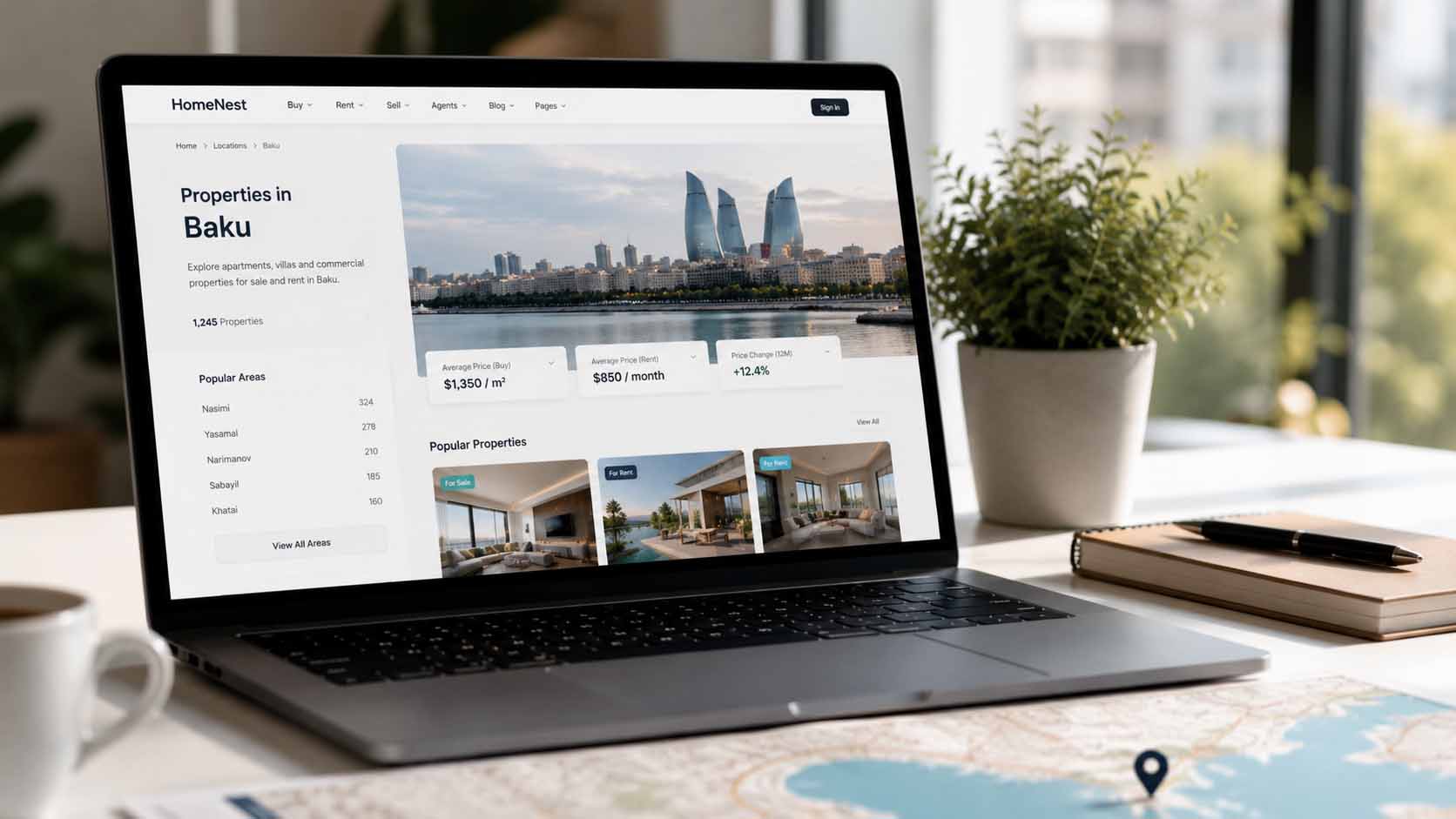
Why Location Pages Matter for Real Estate SEO in 2027
Real estate is one of the most location-driven industries on the web. People rarely search for property in completely generic terms. They usually search with a place in mind. They look for apartments in Baku, villas in Riyadh, properties in Dubai Marina, offices in a specific business district, or homes near a particular neighbourhood. That makes location one of the most important parts of both user experience and SEO.
Real estate is one of the most location-driven industries on the web.
People rarely search for property in completely generic terms. They usually search with a place in mind.
They look for apartments in Baku, villas in Riyadh, properties in Dubai Marina, offices in a specific business district, or homes near a particular neighborhood.
That makes location one of the most important parts of both user experience and SEO.
While working on real estate platform concepts such as HomeNest, one thing becomes clear very quickly: location should not be treated as a simple text field. It should be part of the platform architecture.
When location data is structured properly, it can support search, filtering, navigation, landing pages, analytics, and search engine visibility at the same time.
Users Search by Place Before They Search by Property
A person may not know the name of a specific property, project, or agency.
But they often know where they want to live or invest.
Typical searches might include:
“apartments for sale in Baku”
“villas in Riyadh”
“property in Dubai Marina”
“new apartments near city center”
This is why location pages can become some of the most valuable pages on a real estate platform.
Instead of asking search engines to understand thousands of individual listings independently, a platform can organize those listings around meaningful geographic pages.
For example:
/properties/baku/
/properties/baku/yasamal/
/properties/dubai/dubai-marina/
These pages create a clear structure for both users and search engines.
A Good Location Page Should Be More Than a List
One common mistake is to create a location page that contains only property cards.
Technically, that page works.
But from an SEO and user perspective, it does not provide much context.
A stronger page can include information such as:
- Area overview
- Available property types
- Typical price ranges
- Popular neighborhoods
- Nearby landmarks
- Transportation options
- Schools or universities
- Lifestyle information
- Investment considerations
- Frequently asked questions
The purpose is not to fill the page with generic text.
The goal is to create useful context around the listings.
A visitor should be able to understand not only which properties are available, but also what the location itself is like.
Structured Location Data Makes Everything Easier
Location becomes much harder to manage when every property stores its address differently.
For example, one listing may use:
Baku
another:
Bakı
another:
Baku City
and another:
Central Baku
For humans, these may look similar.
For a database, they can become completely separate values.
That can create problems for:
- Search
- Filtering
- SEO pages
- Analytics
- Reporting
- Navigation
A structured hierarchy is usually much cleaner.
For example:
Country → City → District → Area
or:
Country → City → Community
depending on the market.
This allows properties to inherit a consistent location structure rather than relying on free text.
Location Pages Can Become SEO Landing Pages
Once locations are structured properly, the platform can generate dedicated landing pages.
This creates opportunities to target more specific search intent.
For example:
Baku properties
can target broad searches.
Apartments in Baku
can target a more specific property type.
Apartments in Yasamal
can target an even narrower local audience.
This creates a hierarchy of pages that reflects the way people actually search.
The important part is to avoid generating thousands of thin pages automatically.
A location page should exist because it has real value.
If a page has almost no listings and no useful content, it may not deserve to be indexed.
URLs Matter More Than They Look
A clean URL structure helps both users and search engines understand the relationship between pages.
For example:
/properties/azerbaijan/baku/
is much clearer than:
/search?location=312
The first URL describes the page.
The second URL mostly describes the internal implementation.
A good URL structure can also make breadcrumbs more meaningful.
For example:
Home → Properties → Azerbaijan → Baku
This creates a logical navigation path and helps search engines understand the site hierarchy.
Internal Linking Becomes Much Stronger
Location pages also create natural internal linking opportunities.
A property detail page can link back to:
- its city,
- district,
- area,
- or property type.
A city page can link to popular neighborhoods.
A neighborhood page can link to individual listings.
This creates a connected structure instead of isolated pages.
For SEO, this matters because search engines discover and evaluate pages partly through internal links.
A well-connected real estate platform can make important pages easier to crawl and understand.
Not Every Filter Combination Should Become a Google Page
This is an important distinction.
Users may apply many filters:
- Location
- Price
- Bedrooms
- Property type
- Amenities
- Size
That can create thousands or even millions of possible combinations.
You generally do not want every one of those combinations indexed.
For example:
?city=baku&beds=3&pool=yes&parking=yes
may be perfectly useful for a visitor.
But it does not automatically need to become a search engine landing page.
A better approach is to separate two systems:
Dynamic filters for users
and
Curated landing pages for SEO
This keeps the search experience flexible without creating unnecessary indexable pages.
Location Pages Need Unique Content
If every city page uses the same paragraph with only the city name replaced, the content quickly becomes repetitive.
That is not very useful.
Strong location pages should contain information that genuinely belongs to that location.
For example, a Baku page might discuss:
- central districts,
- coastal areas,
- transportation,
- common property types,
- local development patterns,
- or investment activity.
A Dubai Marina page would naturally have completely different information.
The more specific and useful the page is, the more valuable it becomes to users.
Real Estate SEO Is Closely Connected to Platform Architecture
This is one of the reasons I find real estate platforms interesting from a development perspective.
SEO is not only a marketing layer added after the product is built.
The data model itself influences what SEO opportunities are possible.
If the platform already understands:
- countries,
- cities,
- districts,
- property types,
- agents,
- and listings,
then those relationships can support structured public pages.
If everything is stored as unstructured text, building the same system later becomes much harder.
That is why SEO decisions should sometimes be made during backend architecture planning, not only during content writing.
How This Connects to HomeNest
In HomeNest, the broader goal is to treat property discovery as a structured platform experience rather than a collection of independent listings.
Location plays an important role in that approach.
It affects how users search, how listings are grouped, how filters behave, and how the platform can eventually organize public pages.
This type of structure makes the platform easier to grow over time.
Instead of rebuilding navigation and SEO architecture later, the underlying data can already support that expansion.
Final Thoughts
Location pages can become one of the strongest SEO assets of a real estate platform, but only when they are designed with purpose.
A useful location page should help users understand the area, discover relevant properties, and navigate naturally to more specific pages.
At the same time, the platform should avoid creating endless low-value pages from every possible filter combination.
The best approach is usually a combination of structured location data, clean URLs, useful local content, strong internal linking, and carefully selected indexable landing pages.
In real estate, geography is not just another filter.
It is one of the main ways users think about property.
And when the architecture reflects that, both the user experience and SEO strategy become much stronger.