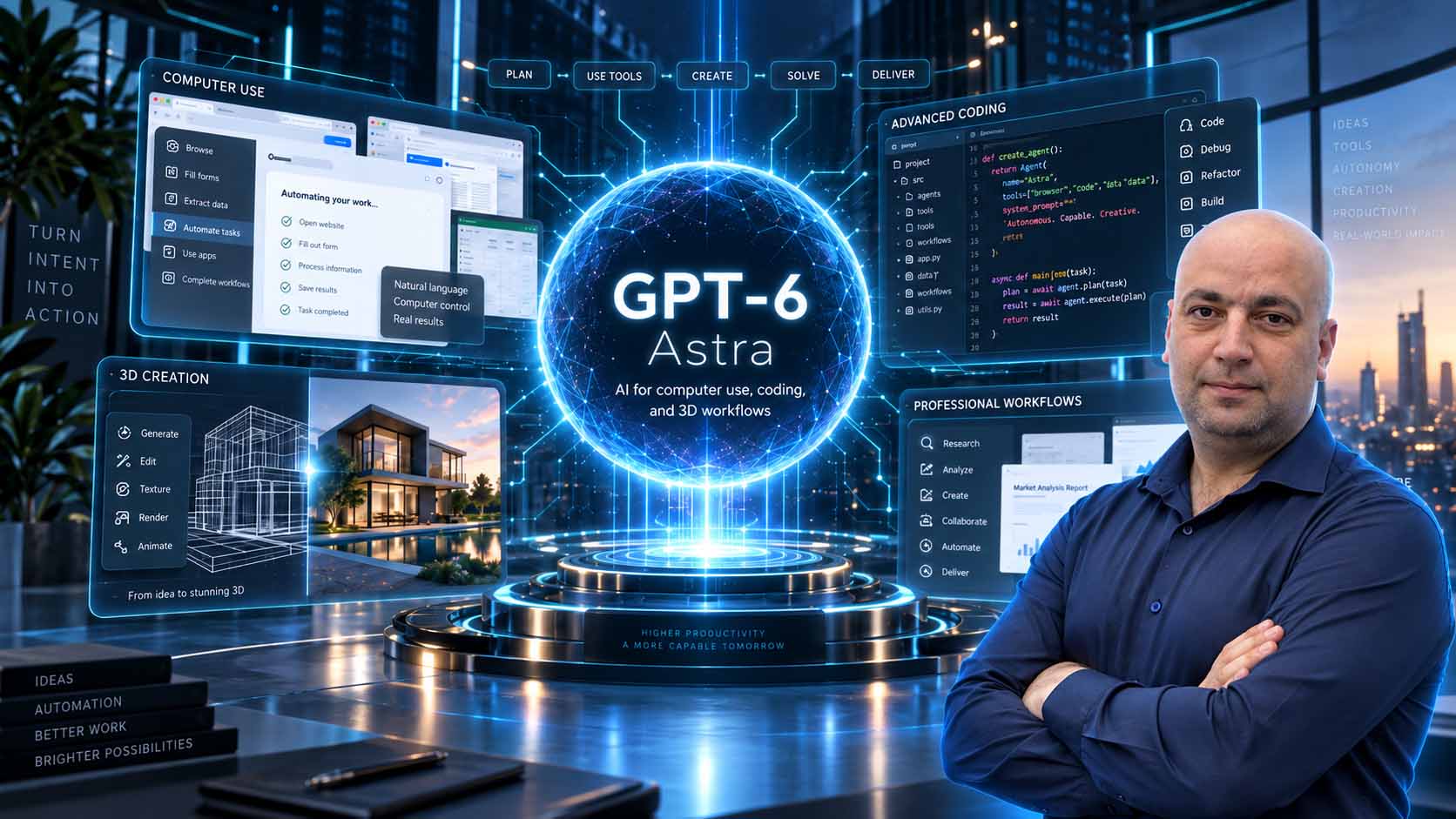
OpenAI Launches GPT-6 Astra, Bringing AI Closer to Autonomous Digital Work
OpenAI has introduced GPT-6 Astra, a new frontier AI model focused on autonomous computer use, advanced coding, 3D workflows, professional automation and AI agents.
OpenAI has introduced GPT-6 Astra, its latest frontier AI model, with major improvements in computer use, software engineering, professional workflows, 3D creation, and autonomous task execution. The company describes Astra as its most capable and aligned model to date.
One of Astra’s biggest changes is that it is designed not only to answer questions, but also to perform complex multi-step digital tasks. According to OpenAI, the model can work with websites and software, organize calendars, update records, conduct online research, create documents and presentations, generate websites, and run frontend quality checks.
Stronger 3D and visual capabilities
Astra also brings significant improvements to visual and 3D workflows. OpenAI says the model demonstrates stronger visual judgment when creating websites, games, applications, and renderings. Its demonstrations include workflows involving Blender models, interactive environments, CAD reconstruction, and playable game prototypes.
On the BenchCAD evaluation, which tests the ability to reconstruct 3D objects from multiple rendered views by generating CAD code, GPT-6 Astra reportedly reached a 95.9% geometric-overlap score, compared with 83.3% for GPT-5.6 Sol.
This direction suggests that generative AI is moving beyond static images toward systems capable of understanding objects, spatial relationships, environments, and interactive experiences.
AI agents that can use computers
Computer use is another major focus of the release. OpenAI reports that Astra scored 72.6% on OSWorld 2.0, compared with 65.7% for GPT-5.6 Sol, while completing simulated computer-use tasks significantly faster.
This means future AI systems may increasingly act as digital agents capable of navigating software, completing forms, researching information, testing applications, and performing routine professional tasks with less manual intervention.
Coding and professional work
OpenAI is also positioning Astra as its strongest software-engineering model so far. The model is designed to handle longer development workflows, make better implementation decisions, test its own work, and require fewer iterations before reaching production-quality results.
Astra also focuses heavily on business productivity. It can create structured documents, spreadsheets, analyses, and presentations while following existing templates and visual styles more closely than earlier generations.
Availability
GPT-6 Astra is initially rolling out to a limited group of organizations, with broader availability planned for ChatGPT Plus, Pro, Business, and Enterprise users. OpenAI also says the model will be available through its API, Microsoft Azure, and AWS Bedrock.
The API model name is expected to be gpt-6-astra, with standard pricing listed at $10 per million input tokens and $50 per million output tokens.
A shift from generative AI to executable AI
The most important part of GPT-6 Astra may not be a single benchmark or feature. It represents a broader shift in artificial intelligence.
Previous generations of AI mainly helped users generate content. Models like Astra are increasingly being designed to understand, decide, operate tools, interact with software, create environments, and complete tasks.
The competitive question may therefore be changing from:
“Which AI can generate the best content?”
to:
“Which AI can turn an idea into a working result with the least human intervention?”
That transition could have major implications for software development, cybersecurity, design, 3D production, gaming, business automation, and digital work in general.